



What pit cover should I choose?
Which trench cover to choose? Aluminium, PVC, guttering or mesh
Comparison of solutions for securing a workshop pit
Securing a workshop pit does not simply consist of installing protection against falls. The chosen device must also be adapted to the frequency of use of the pit, the movements of operators, the type of vehicles maintained, and the daily organization of the workshop.
Motorized aluminum cover, PVC cover, guttering or gutter netting: each technology has advantages but also constraints.
Therefore, there is no universal solution: a very efficient cover for a heavy-duty workshop used daily may be oversized for an occasional pit. Conversely, an economical solution can become cumbersome if it has to be handled several times a day.
This comparison allows you to identify the main criteria to consider before choosing.
What criteria should be considered before choosing a pit cover?
The first criterion is naturally the level of protection sought. But one should not stop at the device’s resistance.
In practice, Xpertive recommends, among other things, taking into account the frequency of opening and closing the pit, the need to operate the protection device, its ease of handling, the length of the pit and the constraints specific to the activity.
Protection that is manipulated several times a day must, in particular, be sufficiently simple to use so that its implementation does not become a constraint for operators.
This is an important principle: the best protection is also the one that is truly integrated into the workshop’s working habits.

Motorized aluminum cover: for which workshops?
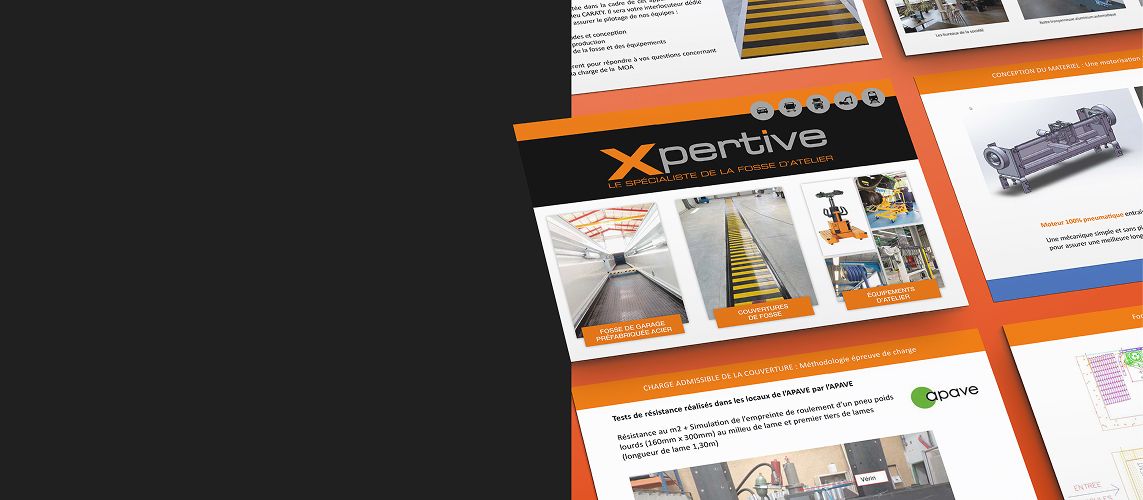
The motorized aluminum cover is the most suitable solution for workshops that intensively use their pit and are looking for resistance, quick handling, and operating comfort.
Its main advantage lies in its simplicity of use: the opening and closing are motorized, which makes it easy to systematically secure the pit between two interventions.
Xpertive offers, among other things, an extruded aluminum cover capable of withstanding 25 tons/m². It allows pedestrian traffic and is designed to withstand the occasional impact of heavy-duty truck tires on the cover. Resistance tests and bag tests were carried out by APAVE.
An aluminum version of 1.5 tons/m² It is also proposed for situations requiring primarily pedestrian traffic and the movement of workshop equipment.
Strengths
Very high level of resistance depending on the chosen version, easy handling thanks to the motorization, pedestrian traffic possible, excellent integration in workshops that frequently require access to their pit and high durability.
Points of attention
The initial investment is higher than with simpler solutions such as PVC or netting. Installation also requires a technical study of the pit and its surroundings.
To be preferred for: heavy-duty workshops, buses and coaches, municipalities, railway maintenance and more generally the pits used on a daily basis.
PVC cover: an economical and easy-to-use alternative
The PVC cover represents an interesting compromise when it is not necessary to circulate on the ditch once it is protected.
The solution developed by Xpertive uses a 650 g/m² PVC tarpaulin combined with steel tubes equipped with ball bearings. Opening and closing is done manually using a strap by moving along the trough.
Its main advantage lies in its simplicity: it is lightweight to handle, quick to install and significantly less expensive than a motorized aluminum cover.
The installation can usually be completed in one day.
Strengths
Controlled investment, simple handling, quick installation, possible adaptation to existing pits, and a good compromise to secure a pit that does not require traffic on its roof.
Points of attention
The PVC cover is not designed to be pedestrian or carable. Its operation remains manual as well: its usefulness must therefore be evaluated based on the frequency with which the pit is opened.
To be preferred for: The workshops are looking for a simple and economical anti-fall protection without the need for circulation above the pit.
Fillet of fish: in which cases is it relevant?
The net constitutes one of the simplest solutions for materializing and protecting the opening of a pit. Its reduced cost and simplicity make it a suitable solution when the use of the pit is occasional and no circulation above it is necessary.
However, it is necessary to distinguish between protection against falling and the restoration of a traffic surface: a net is not designed to be used by pedestrians or to allow the movement of equipment above the pit.
Its effectiveness also depends on its proper implementation with each use.
Strengths
Reduced investment, simple setup, and possible adaptation to many existing pits.
Points of attention
No traffic on the trench, manual handling and the need to check the correct installation of the device at each deployment..
To be preferred for: a pit that is used occasionally when the primary need is to have a simple and economical fall protection system.
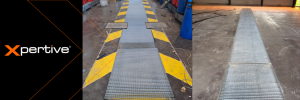
Caillebotis: a robust solution but that must remain practical
The eaves They are a traditional solution for protecting all or part of a pit. They can be made of galvanized steel or polyester and can be complemented by platforms or railings depending on the configuration.
Their main advantages are their robustness and modularity. They can be particularly useful for creating a passageway or protecting a specific part of the pit.
Their limit becomes more apparent when the entire length of a pit needs to be opened and closed regularly. The repeated handling of panels can become cumbersome and must be taken into account in the ergonomic analysis of the workstation.
Strengths
Robust solution, custom design possible, creation of bridges or platforms, and special interest in securing certain specific areas of the pit..
Points of attention
Depending on the material, dimensions and number of elements, handling can be more demanding than with a roll-up cover. Therefore, for a pit that is used daily, the weight, storage and necessary handling must be particularly considered.
To be preferred for: pointy passages, technical platforms, specific areas or pits whose complete opening remains occasional.
What is the best pit cover in the end?
It all depends on how the workshop is used.
For a pit that is accessed several times a day, ease of opening and closing becomes almost as important as the mechanical performance of the protection. A motorized aluminum cover then usually represents the most comfortable and durable solution. When the need primarily consists of preventing falls without having to walk over the pit, a PVC cover can offer a particularly interesting compromise between cost, simplicity and efficiency.
The gabions remain relevant for creating localized passages, platforms or protections. The mesh, on the other hand, is suitable for simpler situations when traffic above the pit is not necessary.
The choice must therefore be made based on actual usage rather than solely on the purchase price.
Comparison to choose according to the use of the workshop
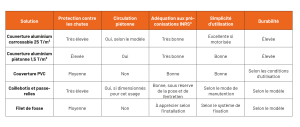
Source and method: Comparative table Xpertive based on the characteristics of its solutions and the prevention criteria presented in the INRS brochure Repair and maintenance of heavy-duty vehicles (ED 6173, chapter «Visit shafts», table 4). The choice of protection must take into account the risk of falling, the conditions of circulation, the ease of maneuverability, and maintenance. Circulation on a cover is only possible if the device is designed for this use, within the load limits set by its manufacturer.
The Xpertive advice: reasoning based on usage costs rather than purchase price
Two products with very different investment profiles can ultimately have usage costs that are much closer over several years.
In a workshop where a pit is opened and closed several times a day, the time spent on handling operations, the physical constraints imposed on operators, the lifespan of the equipment, and the impact on the organization must also be factored into the reasoning. Conversely, it is not necessary to oversize an installation that is used a few times a month.
The frequency of use therefore constitutes one of the best indicators for determining the appropriate level of investment.
That is why Xpertive studies the configuration of the pit and the working habits of the workshop before recommending a protection technology.
Can these protections be installed on an existing pit?
Yes. Security does not only apply to new pits.
An existing concrete pit can, depending on its geometry and condition, be covered with aluminum sheeting, PVC sheeting, or a gabion or mesh fence. A preliminary study makes it possible, among other things, to verify the dimensions, the mounting possibilities, the flow restrictions, and the available space for storing or motorizing the device. This option allows for the securement of many existing workshops without completely rebuilding their pit.
In short: which solution to choose based on your needs?
The choice depends primarily on the use of the pit. For intensive use and repeated openings, a motorized aluminum cover offers a high level of comfort and durability. When no circulation above the pit is required, PVC can provide an excellent compromise between safety and investment. The gratings are particularly suitable for localized passages and platforms, while the mesh meets simpler protection needs.
The frequency of use, circulation, ergonomics, handling and cost of use must therefore be studied together before choosing. Xpertive can study an existing pit or a new project to determine the most suitable protection solution for its actual use.