



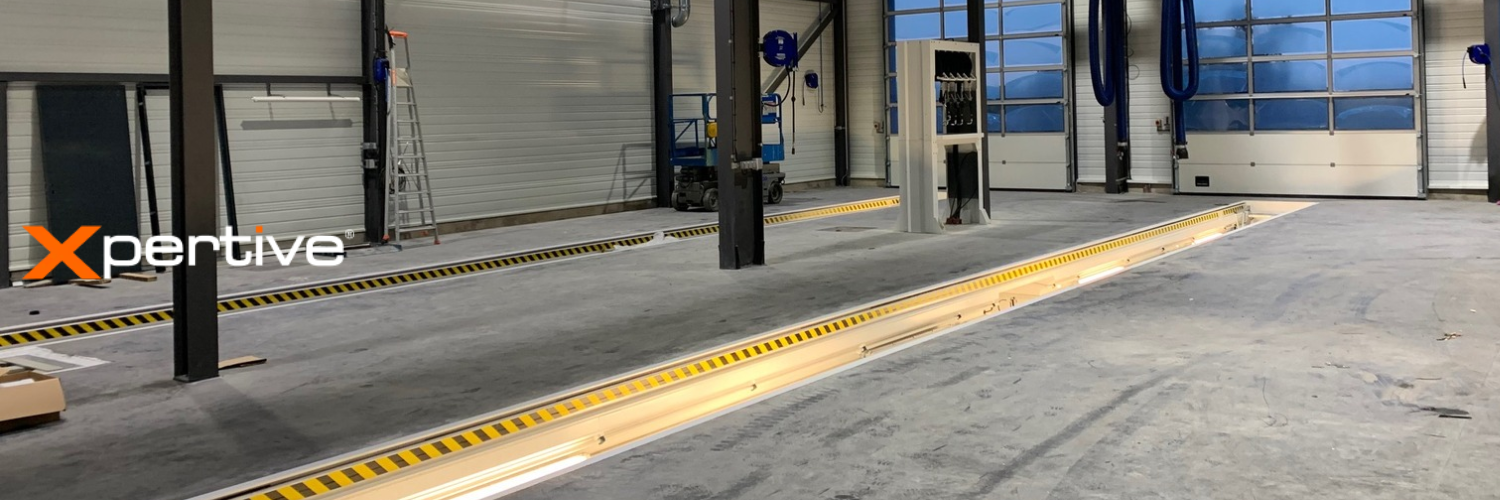

What a maintenance pit for a territorial community
What a maintenance pit for a territorial community?
Communes, intermunicipalities, metropolises or departments often have a particularly diverse fleet of vehicles: utility vehicles, heavy-duty vehicles, household garbage bins, sweepers, tractors, road-building equipment or specialized vehicles.
When part of their maintenance is carried out in-house, the workshop area must be able to accommodate this diversity while ensuring good working conditions for the staff.
The project therefore does not just consist of determining the length and depth of a pit. It is necessary to design a real maintenance station based on the fleet, the interventions carried out, the necessary equipment, and the prevention rules applicable to the territorial communities.
Discover our mechanical sewer system for local authorities
Which communities is a maintenance pit intended for?
A pit may be relevant when a community has a workshop that allows it to carry out regular maintenance, inspection, or repair operations in-house.
This concerns in particular:
- communes with a municipal technical center
- Commune and agglomeration communities
- the metropolises
- the departments
- some trade unions and local public institutions
- technical services with their own workshop
- the structures operating a large fleet of technical vehicles
Interest depends less on the size of the community than on its fleet of vehicles and its maintenance strategy. A community that regularly maintains its vehicles in-house will not have the same needs as a structure that outsources the majority of its operations.
Which vehicles are serviced in a municipal technical center?
This is one of the main characteristics of community workshops: the same pit may have to accommodate extremely different vehicles.
| Type of vehicle | Examples | Constraints to anticipate |
|---|---|---|
| Light commercial vehicles | Trucks, intervention vehicles | Variable wheelbase and heights |
| Heavyweights | Truckers, technical trucks | Length, load, access from the vehicle |
| Waste collection | BOM, collection vehicles | Dimensions, equipment under the chassis |
| Roads | Sweepers, cleaners | Specific architectures and equipment |
| Green spaces | Tractors, technical equipment | Variable road and ground conditions |
| Public works | Excavators, construction equipment | Specific dimensions, weight and access |
| Sanitation | Hydrogenerators, specialized vehicles | Specific equipment and networks |
| Winter viability | Cleaning crews, snow removal vehicles | Equipment brought in and seasonality |
This diversity must be studied before determining the dimensions of the pit. A pit designed solely around today’s most common vehicle may become restrictive after a part of the fleet is renewed.
Discover how the city of Rennes protects its workshops
How to dimension a pit for a fleet of municipal vehicles?
There is no universal dimension for a pit that suits all communities. The length, width and depth must be determined based on several data:
- Dimensions and wheelbase of vehicles
- ground guard
- Maintenance operations carried out
- areas of the vehicle that technicians must access
- equipment integrated into the pit
- number of agents likely to work there
- lifting equipment
- access and exits
- Vehicle circulation in the workshop
- Predictable evolution of the vehicle fleet
The sizing therefore needs to start with the vehicle but also with the use. Two communities that have similar vehicles may need different pits if one carries out only routine maintenance while the other carries out more significant mechanical interventions.
Should the pit be sized for the largest vehicle?
Not necessarily in a systematic way. The right reasoning is rather to establish a matrix between: Vehicles maintained × frequency of use × operations performed.
An exceptionally present vehicle in the workshop does not necessarily determine the entire design by itself. Conversely, a type of vehicle representing a significant part of the maintenance must strongly influence the sizing and the equipment selected.
This analysis prevents two errors: building a well that is not sufficiently versatile, or, conversely, unnecessarily overdimensioning the project.
What equipment should be provided in a technical center pit?
A modern pit is not limited to a volume that allows work to be carried out under a vehicle. Depending on the operations carried out, it can integrate various equipment:
- Lighting. The lighting must be uniform and adapted to the work under the vehicles in order to limit the areas of darkness.
- Ventilation. A pit constitutes a low point. Ventilation must be studied based on the pollutants that may be present and the operations carried out.
- Extraction of exhaust gases. When thermal engines are operating in the workshop, capturing emissions as close as possible to their source is an essential point of prevention.
- Compressed air and electricity. Their integration directly into the pit prevents the multiplication of cables and flexible pipes in the circulation areas.
- Distribution and recovery of fluids. New oil, used oil, or other fluids can be integrated into the post organization.
- Lifting. Suitable lifting equipment allows for intervention on the axles or certain vehicle components from the pit.
- Niches and storage. They facilitate the organization of the workplace and limit the clutter in the work area.
- Protection of the pit. A covering or protective solution must be provided to control the risk of falling when the pit is not in use.
The goal is to bring the technician’s equipment closer together in order to limit unnecessary movements and manipulations.
What regulations apply to a pit in a municipal workshop?
Local authorities have a specific framework regarding health and safety at work. Decree No. 85-603 of June 10, 1985 stipulates, among other things, that the premises and service facilities must be arranged and the equipment installed and maintained in such a way as to guarantee the safety of agents and users.
He also specifies that the territorial authority is responsible for ensuring the safety and protection of the health of the agents under its authority. The rules applicable to local authorities regarding health and safety are, subject to the provisions specific to the territorial public service, those defined, in particular, by books I to V of Part Four of the Labour Code.
A pit located in a municipal technical center must therefore be considered a real workplace, the risks of which must be evaluated and controlled.
Do the R468 and R469 recommendations apply to municipalities?
The R468 and R469 recommendations of the Maladie Insurance – Professional Risks constitute particularly interesting references for the design and use of pits. The R468 concerns the use, design and renovation of the access tunnels for vehicles and machinery. The R469 concerns their design.
They address several topics that are directly applicable to a community workshop:
- fall prevention
- access to the pit
- protection when it is not used
- ventilation
- lighting
- circulation
- organization of the work station
These are recommendations for prevention and not «standards» imposing a single model of pit. They nevertheless provide a very useful technical framework when designing or renovating a workshop.
Can a community secure an old concrete pit?
Yes. The construction of a new pit is not systematically necessary. An existing concrete pit can, depending on its condition and configuration, be modernized to improve its safety and ergonomics.
The works may notably concern:
- the installation of a cover
- The resumption of access
- The improvement of the lighting
- the installation or modification of ventilation
- the capture of exhaust gases
- the integration of fluid networks
- the addition of lifting equipment
- The adaptation of certain areas of civil engineering
This solution can be particularly interesting during the renovation of an existing technical center.
The preliminary study must nevertheless determine whether the current pit is actually compatible with today’s vehicles and maintenance operations.
Pre-fabricated steel pit or concrete pit for a new technical center?
In a new project, the two approaches follow different logics.
A ditch traditionally built in concrete requires coordination between civil engineering and the successive integration of the various equipment. A prefabricated steel pit, on the other hand, is designed upstream as a complete unit that can integrate, from the moment it is manufactured, the locations and provisions necessary for equipment, networks, lighting, ventilation or lifting.
For a community, this approach can be of great interest: fixing more technical parameters before the start of the construction project and reducing the number of interfaces between the different stakeholders.
The choice must nevertheless be made based on the building, the terrain, the schedule, the equipment and the functional program of the workshop.
Who would associate themselves with a sewage project in a community?
The design benefits from associating the various users and responsible parties involved. According to the community organization, the project may involve, among other things:
- the person in charge of the technical center
- the fleet manager
- The maintenance agents
- the prevention/health and safety service
- the building and heritage services
- the public procurement service
- the design and execution of works
- the manufacturer or integrator of the pit
Involving future users also makes it possible to identify operational constraints that do not always appear in a purely technical specification.
In short: how to design a pit adapted to a community?
A maintenance pit for the community must first and foremost be designed around the actual use of the technical center.
The diversity of vehicles requires studying the fleet as a whole. The sizing must then be aligned with the operations carried out, the necessary equipment, the flow of vehicles, and the working conditions of the agents. The regulations applicable to the territorial public service also require the territorial authority to ensure the safety and health protection of its agents. Recommendations R468 and R469 provide a complementary framework particularly useful for the design, use and renovation of pits.
For a new project, as well as for the renovation of an existing pit, anticipating the uses before choosing the technical solution prevents many subsequent adaptations.
Xpertive assists communities in the study, design, equipment, and securing of their maintenance pits, taking into account the fleet, the constraints of the building, and the actual operating conditions.