
Our news
Workshop bench – 7 common mistakes to avoid
Labour Inspection: 7 mistakes to avoid to ensure the safety of your workshop pit
During an inspection by the Labor Inspectorate, a safety audit, or an update of the DUERP, the workshop pit can reveal several risk situations. Deficient protection against falls, unsuitable access, insufficient ventilation or lighting, and movement around the pit during vehicle maneuvers: certain errors are still regularly encountered in workshops.
The prevention of risks related to pits relies on the obligations of the Labour Code and on the R468 and R469 recommendations. Since 2014, Xpertive has relied on its field experience, with more than 50 prefabricated pits installed and more than 100 covers deployed each year in France.
Here are 7 mistakes to identify before they become a problem.
Mistake 1: Leaving an open pit when it is not in use
This is obviously the first risk associated with a maintenance pit: when no vehicle covers it, it forms an opening that is directly accessible from the work area.
In an active workshop, the danger is accentuated by frequent movements, the transport of tools or parts, simultaneous interventions, and the possible presence of people less familiar with the premises.
The topic remains very relevant. In a report published in May 2026, Work & Safety, For example, the INRS monthly magazine presents an article on a workshop in which some pits exceed 20 meters in length and where testing of guardrails is carried out to better protect mechanics from falls.
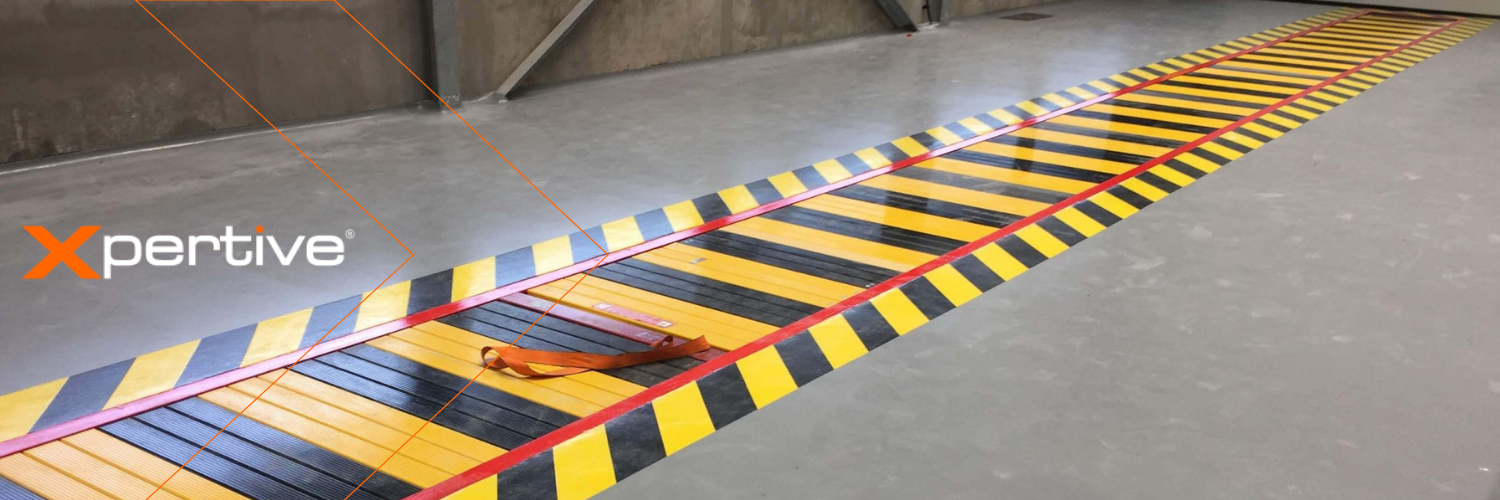
Physical protection for the pit must therefore be considered a real piece of work equipment: rigid or flexible cover, netting or other devices adapted to analyzing the risks and to the constraints of the workshop.
Discover our garage pit cover solutions
Error 2: To think that marking the ground is enough to secure the pit
A band of paint, a «danger» sign or markings alert operators to the presence of a pit. However, they do not physically eliminate the risk of falling.
Prevention should prioritize solutions that directly address the risk. For a pit, this leads to examining the possibility of implementing an appropriate collective protection system.This distinction is important: signaling danger and preventing a fall are two different things.
In a workshop where there are many movements, where several teams are working simultaneously, or where external people may be present, knowing the existence of the pit cannot constitute the entire prevention strategy.
Mistake 3: Choosing effective protection on paper but burdensome in everyday life
This is a less obvious mistake, but particularly important in the field.
A security device can be technically relevant and yet be poorly used if it is too heavy, too long to install, or incompatible with the daily operation of the workshop. Field experience shows that truly effective protection must also be easy to use. This is especially true for long pits or those frequently used.
When choosing a pit cover, it is therefore necessary to consider its level of protection, its resistance, its handling time, and its integration into working habits simultaneously. A good security solution is one that will actually be used.
Mistake 4: Forgetting that the risk is not limited to the fall
When we talk about the safety of a workshop pit, the fall is often the first danger that comes to mind. However, it is not the only one. The INRS reminds that automotive and heavy-duty vehicle repair activities expose employees to different types of risks: falls and slips, hazardous substances, handling operations and physical strain.
In a pit, particular attention must be paid to ventilation and exposure to exhaust gases. Lighting, access, the recovery of used oils, and the ergonomics of the workstations must also be factored into the design.
The good question is therefore not simply:
«How do I cover my workshop pit?» but rather: «How can I make working in the pit safer?» and «How can I secure my garage pit as a whole?»
It is this comprehensive approach that Xpertive prioritizes in the design of its steel prefabricated tanks, as well as in the modernization of existing installations.
Error 5: Waiting for an inspection to discover that the pit poses a problem
Another situation that is often encountered is dealing with the safety of the pit too late: after an audit, during a reorganization of the workshop, or when the question of compliance becomes urgent. However, Recommendation R468 specifically addresses the use, design and renovation of vehicle and machinery access tunnels. Recommendation R469 complements this approach for their design.
An old pit therefore deserves to be regularly reassessed in light of its current use. The workshop’s activities may have evolved, the vehicles maintained may have changed, new equipment may have been installed, or the traffic flows may have been modified. A pit that was adapted fifteen or twenty years ago is not necessarily still suitable today.
Mistake 6: Discovering security constraints too late during a new project
The problem does not only concern the existing pits. In a project involving the complete construction or renovation of a workshop, a common mistake is to consider the pit as a simple civil engineering structure and to treat its equipment at a later stage. But the pit influences much of the future workshop’s operation: dimensions, access, ventilation, lighting, energy networks, oil recovery, lifting equipment, circulation, and protection against falls.
The later the subjects are integrated, the more complex the interfaces between the architect, the design office, the mason, the electrician, the plumber, and the equipment suppliers become.
Xpertive therefore recommends integrating the pit and its equipment from the very early stages of the architect’s design. A prefabricated steel pit, for example, allows for work to be carried out upstream on a complete equipment system, designed to measure and whose various interfaces are defined before the project begins. This anticipation reduces the risks of errors, rework and additional costs.
Discover our assistance services for contracting authorities
Error 7: Treating compliance independently from the actual use of the workshop
There is no universal solution that suits all pits.
A maintenance pit heavyweights Used all day, one railway tunnel At 26 meters, a technical inspection pit or a municipal facility that accommodates different types of vehicles does not exactly present the same constraints.
The choice must therefore be based on real usage:
- Which vehicles are being maintained?
- How often is the pit used?
- Do I need to be able to pass over it when it is closed?
- What equipment is already present?
- What are the access and circulation constraints?
- How do the technicians actually work?
This analysis makes it possible to avoid a purely theoretical compliance process and to opt for a solution that balances prevention, ergonomics and productivity.
At the SNCF train station in Calais, For example, Xpertive recently had to custom design a 25 T/m² cover for an existing 26-meter concrete pit. The site constraints required specific installation on brackets, a dedicated chassis for the motorization, and a storage system adapted to the operation. The goal was twofold: to secure the pit without compromising the site’s productivity.
What Xpertive recommends before a control or a compliance project
The best strategy is not to wait for a non-compliance or a dangerous situation to be detected before examining the pit.
A preliminary diagnosis should allow the observation of protection against falls, as well as access, the general condition of the pit, circulation, lighting, ventilation, the equipment used, and the actual conditions of the intervention. It then becomes possible to prioritize the actions: some can be carried out quickly on an existing pit, while others require a more comprehensive reflection on the organization of the maintenance position.
With more than ten years of experience in the workshop, Xpertive also works on existing installations as well as on new projects. Its design office allows it to design customized solutions and integrate the necessary equipment for working in the workshop: fall protection covers, ventilation, lighting, recovery of used oils, lifting beams and crossbars, and diagnostic equipment.
The goal is not simply to «pass a check», but to have a safe, functional pit that is truly adapted to everyday work.

Summary
The safety of a workshop pit is evaluated as a whole: protection against falls, access, ventilation, lighting and circulation. Among the mistakes to avoid are leaving the pit open, relying solely on markings on the ground or choosing a protection that is too cumbersome to use.
Anticipating risks before a control and integrating security from the design phase allow for limiting costly adaptations. On an existing installation as well as on a new project, Xpertive recommends a diagnosis based on real usage patterns to reconcile prevention, ergonomics, and efficiency in day-to-day operations.